Live Support
 Did you see us on the news?
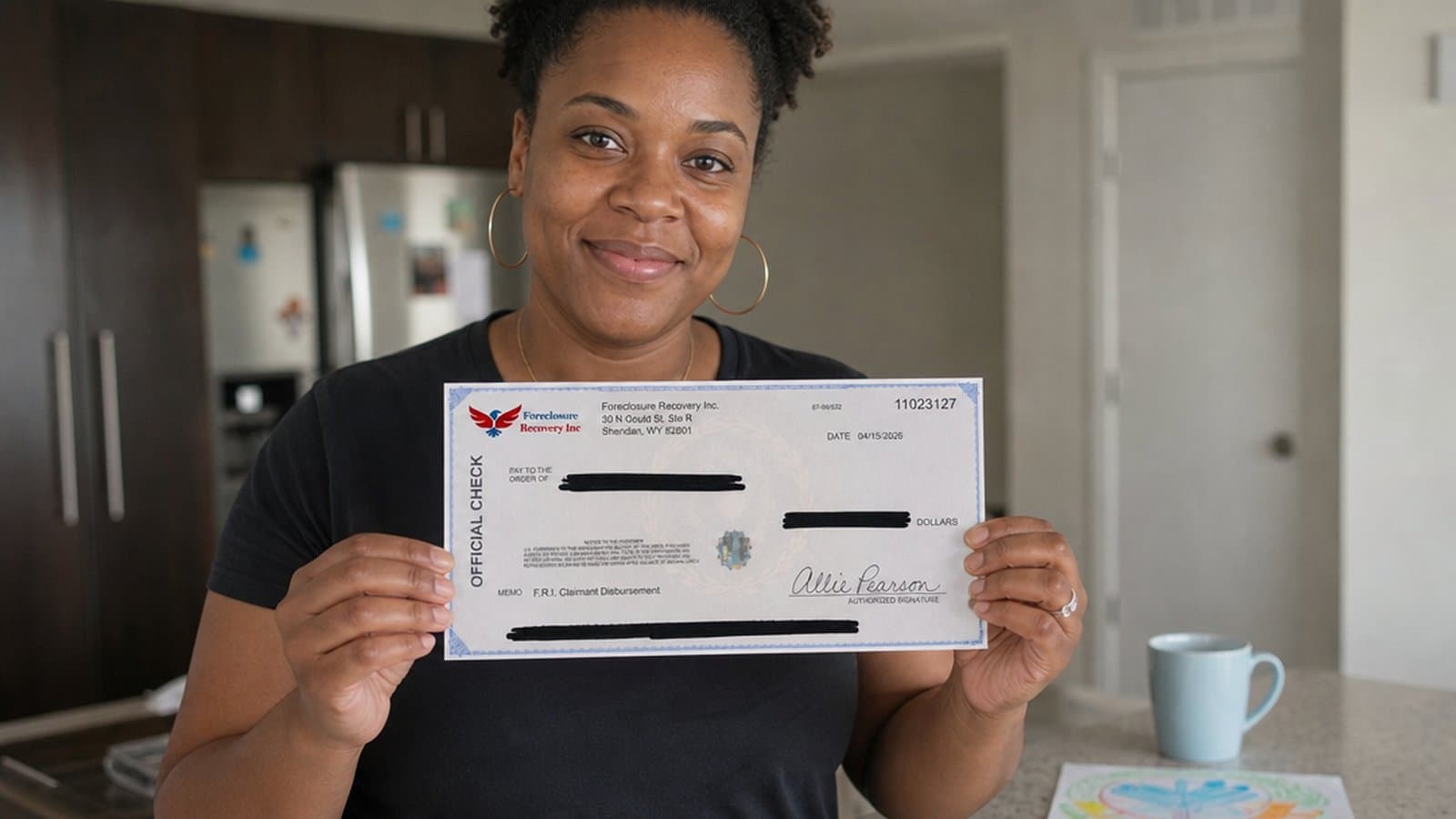
Single Mother Receives $23,500 Check After Mortgage Foreclosure
The short answer
A mortgage foreclosure can leave money behind. If the auction bid clears the loan payoff, the fees, and the costs of sale, what remains is a mortgage overage that belongs to the former homeowner. Keisha lost her Florida home, moved out of state, and assumed the foreclosure had wiped out everything she had put into the property. About $23,500 in surplus was waiting under her name. We located her through skip tracing, walked her through the paperwork, and the claim paid out.
Losing the house is not the same as losing the equity
Most people treat a foreclosure as a total loss. The keys go back, the credit takes the hit, and the assumption is that whatever was paid into the house is gone. That assumption is right often enough to feel true. It is also wrong in a meaningful number of cases, and nobody goes out of their way to correct it.
Keisha had owned her home for nine years. She had refinanced once, then hit a stretch of medical bills and reduced hours. By the time the sale happened, the payoff figure on her loan was around $141,000. The property sold at auction for $172,000. After the lender was made whole and the costs of sale came out, roughly $23,500 was left.
The paper trail stopped at an empty house
Keisha had already moved when the sale went through. She was living in a different state, in an apartment leased under a relative's name while she got back on her feet. Any notice about the surplus went to the property that had just been sold out from under her.
This is the single biggest reason surplus money goes unclaimed. The system mails to the address of record. The address of record is the foreclosed property. The former owner is, by definition, no longer there. Nobody is doing anything wrong, and the outcome is still that the person entitled to the money never hears about it.
How we found her
Skip tracing is less dramatic than it sounds. It is a set of data sources cross-referenced against each other until a current phone number or address surfaces with enough confidence to justify a call. In Keisha's file the match came through a phone number tied to her name across two prior addresses, confirmed by a relative match in the same metropolitan area.
We called on a Tuesday afternoon. She hung up. That is a completely reasonable response, and we get it a lot. People who have just been through a foreclosure are on every predatory list in the country. A voice saying there is money waiting for you sounds like the opening line of a scam because it usually is.
What changed her mind was the public record. We mailed her the sale documents, the bid amount, and the payoff figure, with the arithmetic laid out on one page. She checked it against her own loan statements. The numbers matched, so she called back.
What the claim required
- A notarized claim form identifying her as the former owner of record
- Certified copies of the sale documents and the final accounting
- Photo identification matching the name on the deed
- A payoff statement from the lender confirming the debt was satisfied
- A title search confirming no other party held a superior claim to the funds
- Documentation of her name change from a prior marriage, which appeared on the older deed
The name change nearly derailed the filing. The deed carried her married name and her identification carried her current name. Without a certified copy of the decree tying the two together, the reviewing office had no way to confirm that the person filing was the person on the deed. That one document added three weeks.
The lien check that could have ended it
Before filing, we ran a search for recorded interests against the property. A second mortgage, a tax lien, a judgment, or an association assessment can all reach the surplus before the former owner does. Keisha had a medical collection judgment from four years earlier. It had never been recorded against the property, which meant it did not attach to the funds. Had it been recorded, a portion of the money would have gone to satisfy it first.
We tell every claimant to expect this check, because the answer changes the number. Being owed surplus funds and receiving all of the surplus funds are two different outcomes.
Timeline
| Stage | Elapsed time |
|---|---|
| Surplus identified in the sale record | Day 0 |
| Claimant located through skip tracing | Day 12 |
| First contact declined | Day 12 |
| Documentation packet mailed, agreement signed | Day 26 |
| Name change decree obtained | Day 47 |
| Claim filed | Day 52 |
| Funds disbursed | Day 148 |
If you lost a home to a mortgage foreclosure
Pull two numbers. The first is the amount your property sold for at auction. The second is the total payoff on your loan at the time of sale, including accrued interest and fees. Both are recorded. If the first number is bigger than the second, there was probably a surplus, and it is probably still sitting in a state account under your name.
Then check the deadline. Claim windows run on a clock that started the day the property sold, and they are unforgiving. Waiting is the one thing that reliably costs people the money.
We can run the check for you. Call (888) 545-8007 and we will tell you what the record shows, including when the record shows nothing.
Names and identifying details in this account have been changed to protect client privacy. Every claim is different, and the outcome of one recovery does not predict the outcome of another. Foreclosure Recovery Inc. is an asset recovery administration service and does not provide legal or tax advice.
Frequently asked questions
What is a mortgage overage?
A mortgage overage is the money left after a foreclosed property sells for more than the loan payoff plus the costs of sale. It is the same thing as foreclosure surplus funds or excess proceeds, and it belongs to the former owner rather than to the lender.
Can I claim surplus funds if I moved out of state?
Yes. The claim is tied to the property and to your identity as the former owner of record, not to where you live now. You will need identification and a current mailing address for disbursement, and the filing itself happens where the property sold.
What happens to surplus funds if nobody claims them?
The state holds the funds through a statutory claim window. When the window expires the money is generally absorbed and the former owner loses the right to it. Windows commonly run from one to five years from the sale date.
Will a judgment or lien take my surplus funds?
It can. Recorded interests against the property, including second mortgages, tax liens, judgments, and association assessments, are usually paid from the surplus before the former owner receives anything. A title search before filing tells you what you are actually claiming.
Does claiming surplus funds affect my credit or my foreclosure record?
No. Claiming money that already belongs to you does not reverse the foreclosure and does not change how it reports. It returns equity that was left over after the debt was satisfied.
Think there may be surplus funds in your name?
We check the sale record at no cost and we will tell you plainly if there is nothing there. No fee is owed unless funds are recovered.
(888) 545-8007